Home
Treatments
Research
Advisors
Management
Contact Us
Home
Treatments
Research
Advisors
Management
Contact Us

Treatment of obese mice with ZKCPr1 effectively and dose dependently reduces excess visceral fat, general obesity, and the studied related metabolic disorders whether administered via a systemic method (intravenous, subcutaneous) or orally. As a general rule about 3-5-times more ZKCPr1 is needed to have large effects on general obesity versus visceral fat, when treatment is administered by a systemic method.
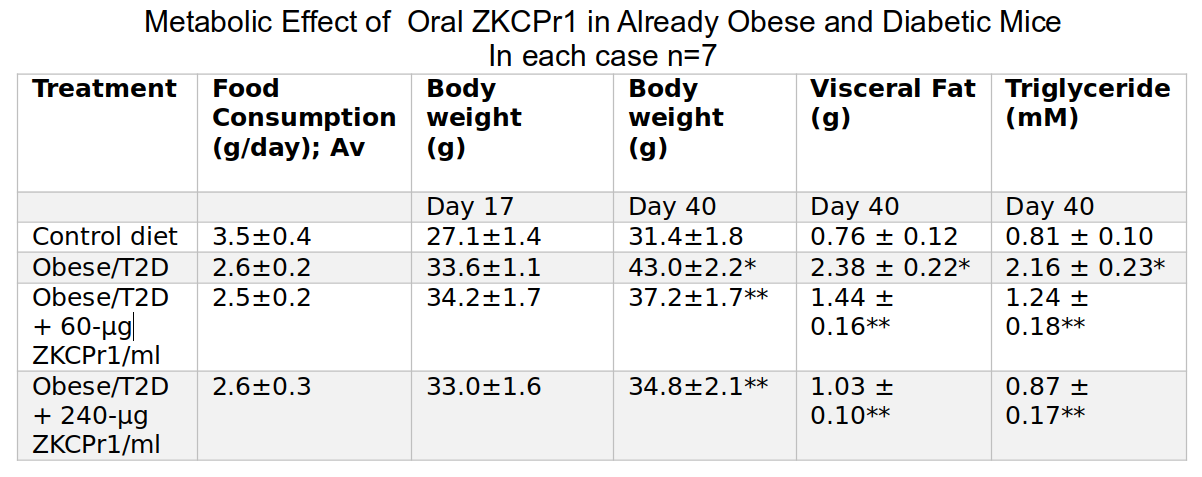
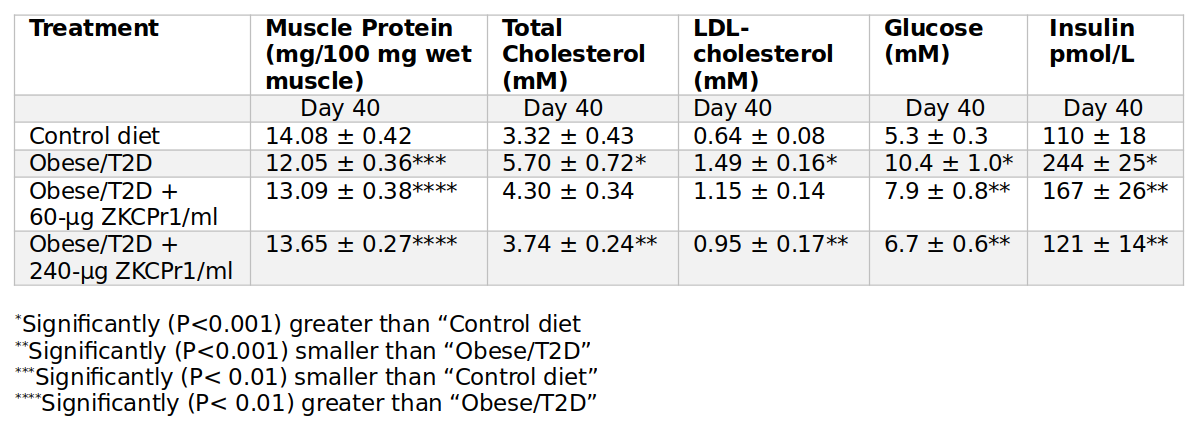
As an example, below an experiment is presented wherein obese/diabetic mice were treated with orally administered ZKCPr1. Six-week-old female C57BL/6 mice were divided into four groups each group consisting of seven mice. Group 1 received standard chow diet (SD) while Groups 2 through 4 were provided a high-fat diet (HFD) All groups were maintained on their respective diets for 16 days without treatment with ZKCPr1.
Beginning on day 17 and continuing through day 40, Group 1 continued on SD, while Groups 2 through 4 remained on the HFD. During this period, Groups 3 and 4 also received fresh water containing ZKCPr1 for 23 consecutive days; specifically, Group 3 received 60 μg ZKCPr1/ml water, and Group 4 received 240 μg ZKCPr1/ml water in both cases ZKCPr1 provided daily from 9 p.m. to 9 a.m. All procedures for which the data is shown in the TABLE below were performed on day 40. Blood samples for glucose, serum lipids, and insulin measurements were collected from the eye corner. After the body weight of each mouse was recorded, the animals were euthanized by cervical dislocation. The gastrocnemius muscle was isolated for assessments of muscle weight and total protein content. For surgical removal and measurement of visceral fat the technique described by others was used [Gabriely, I., Ma, X.H., Yang, X.M. et al. Removal of visceral fat prevents insulin resistance and glucose intolerance of aging: an adipokine-mediated process? Diabetes, 51, 2951-2958, 2002].